- You are here:
- News

- Archive News
- Publications
Publications
Protecting Forest and Marine Biodiversity The Role of Law
 Edited by Ed Couzens, Associate Professor, The University of Sydney Law School, Australia, Alexander Paterson, Professor, Institute of Marine and Environmental Law, Faculty of Law, University of Cape Town, South Africa, Sophie Riley, Senior lecturer, University of Technology Sydney, Australia and Yanti Fristikawati, Dean and Lecturer in the Faculty of Law, Atma Jaya Catholic University of Indonesia, Indonesia
This timely book considers appropriate legal practices to use to promote conservation, protection and sustainable use of biological diversity in forest and marine areas. The breadth of issues explored across these two themes is immense, and the book identifies both key differences, and striking commonalities between them.
Law-makers, managers and users often have little understanding of either the complexity or the true value of biological diversity and of what is needed to preserve forest and marine ecosystems, and to keep inter-relationships between species within them healthy. Regulators face significant and practical challenges, requiring the adoption of legal frameworks in the context of scientific uncertainty. This book provides critical and comparative reflections on the role of law in both of these biodiversity contexts. Key issues not previously addressed through the law are considered – for example, the lack of international governance of peat; and the moral problem of labelling certain species as ‘alien’ or ‘invasive’. Learned contributors draw valuable lessons for those seeking to protect biodiversity and understand its governance, from analysis of experiences gained forging international and national legal frameworks.
With a blend of local and global perspectives, across a wide range of countries and policies, the book will appeal to academics and students in law, international, regional and domestic policymakers, lawmakers, NGOs and conservation agencies.
‘The book is recommended for all libraries that deal with wildlife law and is complemented with a comprehensive index.’
– UKELA
Contributors: C. Costa de Oliveira, E. Couzens, T. Daya-Winterbottom, M. Fajardo Cavalcanti de Albuquerque, Y. Fristikawati, L. Heng Lye, B. Liu, S. Maljean-Dubois, G. Morgan, A. Paterson, A. Prasad Pant, Y. Pei, V.S. Radovich, S. Riley, N.A. Robinson, A. Telesetsky, S.C.-W. Yang
ISBN and details > 2017 352 pp :
- Hardback 978 1 78643 948 2 $155.00
- Paperback 978 1 78990 428 4 $55.00
- eBook 978 1 78643 949 9 $42.21 2017
Courts and the Environment
 Edited by Christina Voigt, Professor, Faculty of Law, University of Oslo, Norway and Zen Makuch, Director, Sustainable Transitions, Imperial College London, UK and Barrister
This discerning book examines the challenges, opportunities and solutions for courts adjudicating on environmental cases. It offers a critical analysis of the practice and judgments of courts from various representative and influential jurisdictions.
Through the analysis and comparison of court practices and case law across global domestic courts as varied as the National Green Tribunal in India, the Land and Environment Court in Australia, and the District Court of The Hague in the Netherlands, the expert contributors bring together a wealth of knowledge in order to enhance mutual learning and understanding towards an environmental rule of law. In doing so, they illustrate that courts play a vital role in the formation and crystallization of rulings and decisions to protect and conserve the environment. Ultimately, they prove that there are many lessons to be learnt from other legal systems in seeking to maintain and enhance the environmental rule of law.
Contemporary and global in scope, Courts and the Environment is essential reading for scholars and students of environmental law, as well as judges, legal practitioners and policymakers interested in understanding the legal challenges to and the legal basis for protecting environmental values in courts.
‘This book is a survival tool for judges who are increasingly required to respond to legal action meant to protect the earth from the existential threat to human civilization posed by global warming. Christina Voigt and Zen Makuch have assembled authors who affirm that there is no greater force to protect Earth and its habitants than the environmental rule of law.’
– Michael D. Wilson, Hawaii Supreme Court, US
‘From pioneers to latecomers, the role of Courts in relation to environmental protection has oscillated in ways that make their overall contribution difficult to assess. This book is a significant addition to the mapping and stock-taking effort. It shows that, in practice, Courts are indeed playing a very important role in adapting legal systems to the need to conserve the environment.’
– Jorge E. Viñuales, University of Cambridge, UK
Contributors: A. Bengtsson, L. Butterly, O. Chornous, T. Daya-Winterbottom, Y.K. Dewi, G.E.K. Dzah, H.S. Ferreira, R. Guidone, D. Hodas, A. Jayadi, S. Jolly, H. Jonas, A. Kennedy, N. Kichigin, E. Lamprea, M.A. Leon Moreta, B Liu, Z. Makuch, P. Martin, R.L.M. Mendes, N.H.T. Nam, A.M. Páez, R. Pepper, B. Preston, N. Robinson, D.A. Serraglio, O. Spijkers, C. Voigt, Z. Zhang
ISBN and details > 2018 456 pp
- Hardback 978 1 78811 466 0 $166.50
- eBook 978 1 78811 467 7 $42.21 2018
Energy, governance and sustainability
 Edited by Jordi Jaria i Manzano, Universitat Rovira i Virgili, Spain, Nathalie Chalifour, University of Ottawa, Canada and Louis J. Kotzé, North-West University, South Africa
'The book brings together scholars from all over the world to address issues of energy governance and sustainability. It provides a unique insight into the nexus between theory, human rights constitutionalism, environmental justice and the practical application of energy policy and legislation ranging from energy supply, renewable energy, energy markets and financing to hydraulic fracturing and energy efficiency. The book brings perspectives from the developed and developing world and proposes recommendations on how the energy crisis can be addressed from a legal perspective. Although the book is written from a legal perspective, scholars and practitioners from other disciplines will also find the book insightful.'
– Willemien Du Plessis, North-West University, South Africa.
ISBN and details >May 2016 352 pp:
- Hardback 978 1 78536 811 0 £90.00 (UK/RoW)
- July 2016 $145.00 (N/S America)
- Elgaronline 978 1 78536 846 2 $42.21 2016
- Paperback $55.00
The IUCN Academy of Environmental Law series
* 30% discount rate applies to members from OECD countries: £63.00/$101.50 (code: IUCN30)
* 60% discount rate applies to members from non-OECD countries: £36.00/$56.00 (code: IUCN60)
The Law and Policy of Biofuels
 Edited by Yves Le Bouthillier, University of Ottawa, Canada, Annette Cowie, University of New England, Paul Martin, University of New England, Armidale NSW, Australia and Heather McLeod-Kilmurray, University of Ottawa, Canada
In the last twenty years the biofuels industry has developed rapidly in many regions of the world. This book provides an in-depth and critical study of the law and policies in many of the key biofuels producing countries, such as Brazil, China, the US, as well as the EU, and a number of other countries where this industry is quickly developing. The multidisciplinary contributors examine the roles of the public and private sectors in the governance of biofuels. They propose recommendations for more effective and efficient biofuel policies.
ISBN and details > May 2016 488 pp
- Hardback 978 1 78254 454 8 £110.00
- July 2016 $175.00 (N/S America)
- Paperback $65.00
- Elgaronline 978 1 78254 455 5 $42.21 2016
The IUCN Academy of Environmental Law series
* 30% discount rate applies to members from OECD countries: £77.00/$122.50 (code: IUCN30)
* 60% discount rate applies to members from non-OECD countries: £44.00/$70.00 (code: IUCN60)
Implementing Environmental Law

Edited by Paul Martin and Amanda Kennedy, University of New England, Armidale NSW, Australia
'The effective implementation as distinct from the enforcement of environmental laws depends upon a range of discrete factors. These include institutional, cultural, social, economic, political as well as traditional legal influences and perspectives. This series of essays explains and analyses the theoretical underpinnings of the relationship between all of these factors and the methodology appropriate to determining in practice whether environmental laws are being implemented so that their objectives are being achieved. This involves a review of the growing theoretical literature and a discussion of a significant number of examples, international, regional, national and local, which assess the extent of effective implementation of the relevant legal rules. The strength of these essays is two fold: the depth of the theoretical discourse and the breadth of the indicative practical examples. These essays will add considerable grist to the intellectual mill of those interested in the perception of environmental governance as an emerging global system.'
– Douglas Fisher, Queensland University of Technology, Australia
This insightful book explores why implementation of environmental law is too often ineffective in achieving effective environmental governance. It provides careful analysis and innovative proposals to help improve the practical effectiveness of legal instruments for environmental governance.
A growing number of organisations including the IUCN, UNEP and the Organisation of American States have voiced concerns that legal instruments that were developed to pursue more convincing environmental governance over the last 40 years are not creating a sufficiently potent system of environmental governance. In response to this challenge, this timely book explores how to bridge the significant implementation gap between the objectives of environmental law and the real-world outcomes of its application. Expert contributors discuss different forms of law, from international conventions down to inter-parties agreements, and non-government codes and standards. The overarching discussion highlights the diverse factors that impact upon implementing environmental law in practice, and considers the limitations and opportunities for constructive innovation in legal governance.
Contributors include: R. Bartel, A.K. Butzel, D. Craig, J. de L. De Cendra, M. Doelle, J. Gooch, W.S. Gumley, C. Holley, T. Howard, W. Lahey, A. Lawson, E. Lees, P. Martin, M. Masterton, P. Noble, R. Ottinger, R.O. Omondi, L. Paddock, J.L. Parker, G. Pink, A. Rieu-Clarke, N.A. Robinson, G. Rose, T.L Rucinski, S. Teles Da Silva, R.R. Valova, X. Wang, M.E. Wieder
ISBN and details > August 2015 c 384 pp :
- Hardback 978 1 78347 929 0 £95.00
- Paperback $45.00
- eBook 978 1 78347 931 3 $42.21 2015
30% discount rate applies to members from OECD countries: £66.50/$105.00 (online ordering code: IUCN30)
60% discount rate applies to members from non-OECD countries: £38.00/$60.00 (online ordering code: IUCN60)
The Search for Environmental Justice
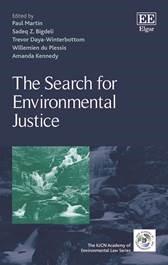 Edited by Paul Martin, University of New England, Armidale NSW, Australia, Sadeq Z. Bigdeli and Trevor Daya-Winterbottom, University of Waikato, New Zealand, Willemien du Plessis, North-West University, South Africa and Amanda Kennedy, University of New England, Armidale NSW, Australia
‘This is an extended and remarkable excursus into the evolving concept of environmental justice. The Editors have woven several nuggets from various scholars and jurisdictions into an impressive mosaic that will resonate for a long time in this nascent literature. The IUCN Academy of Environmental Law is emerging as an important facilitator of conceptual norms of international environmental law and justice. The welcome drift in the direction of “environmental justice” is so compelling that the UNEP Governing Council has recently adopted the first internationally negotiated document to establish the supportive “environmental rule of law”. As a player in the important jurisprudence from South Asia on environmental justice, I stand in reverential awe of this tour de force of experiences in other regions toward the promotion of good environmental governance and environmental social justice.’
– Parvez Hassan, Hassan and Hassan (Advocates), Pakistan
‘This book makes a very useful contribution to the literature on environmental justice through a series of varied, diverse and distinct contributions that map different areas of this multi-faceted topic. The diverse positions advocated reflect the difficult challenges ahead towards ensuring environmental protection in an equitable and just manner at the national and international levels.’
– Philippe Cullet, SOAS, University of London, UK
This thoughtful book provides an overview of the major developments in the theory and practice of ‘environmental justice’. It illustrates the direction of the evolution of rights of nature and exposes the diverse meanings and practical uses of the concept of environmental justice in different jurisdictions, and their implications for the law, society and the environment.
The term 'environmental justice' has different meanings to different scholars and is applied in many different contexts. For some, the focus is on equal distribution of the earth’s benefits, with concern for the interests of the less wealthy, disadvantaged minorities, or indigenous peoples. For others, the focus is on the interests of the earth and nature itself. Additionally, for some, environmental justice is a framework for discourse, whilst for others it connotes specific legal principles and procedures. The application of these interpretations through the law involves diverse approaches and rules. In this timely book, expert contributors identify the meanings and the practical translations of environmental justice, reflecting the perspectives of academic, judicial and indigenous people from many countries. Among the issues considered are the rights of nature and its application through judicial practice, and approaches to respecting the laws, cultures and the rights of Indigenous peoples.
Contributors: J. Aseron, S.Z. Bigdeli, K. Bosselman, C. Chaulk, J.I. Colón-Ríos, D. Craig, T. Daya-Winterbottom, W. Du Plessis, B. France-Hudson, E. Gachenga, S. Glazebrook, L. Godden, N. Greymorning, R. Karky, A. Keene, A. Kennedy, J. Khatarina, P. Martin, E. O’Connell, M. Perry, W. Phromlah, B.J. Preston, V. Rive, J.G. Rose, M.A. Santosa, A.S. Suwana, A. Telesetsky, J. Williams
ISBN and details > 2015 384 pp
- Hardback 978 1 78471 941 8 £95.00
- Paperback $55.00
- eBook 978 1 78471 942 5 $42.21 2015
Water and the Law Towards Sustainability
 Edited by Michael Kidd, University of KwaZulu-Natal, South Africa, Loretta Feris, University of Cape Town, South Africa, Tumai Murombo, University of Witwatersrand, Johannesburg, South Africa and Alejandro Iza, IUCN Environmental Law Centre, Germany
Contributors: H. Alebachew, A. Bodart, J.C.L. da Silva, T. Daya-Winterbottom, M.D. dos Santos, D. du Toit, C. Dutra, D.E. Fisher, A. Foerster, E.B. Kasimbazi, G. Keremane, N. Lugaresi, V.G. Magalhães, J. McKay, A.R. Paterson, R. Pejan, S. Pollard, N. Soininen, I.U. Tappeiner, M. van Rijswick, P. Wouters, Z. Wu
Water and the Law examines the critical relationship between law and the management of water resources in the context of ensuring environmental sustainability. It highlights the central importance of integrated water resources management and cooperation in achieving sustainability.
The book considers two broad themes that are critical for life on Earth: how law can contribute to the sustainability of water itself and how the law’s regulation of water can contribute to the sustainability of life - both human life as well as that of other species in their natural environment. The expert contributors highlight that current approaches to water governance embrace integrated water resources management and appreciation of the holistic nature of the hydrological cycle. In addition to the recognition of the nature of water, there is also an apparent need for addressing water concerns in a cooperative manner.
Capturing the complexities and challenges of protecting water as a resource on the one hand and utilizing it as a service on the other, this thought-provoking book will prove a valuable resource for researchers and students of both water law, and the nexus of environmental law with human rights.
ISBN and details > 2014 416 pp
- Hardback 978 1 78347 960 3 £95.00
- Paperback $55.00
- Elgaronline 978 1 78347 962 7 $42.21 2014
The IUCN Academy of Environmental Law series
* 30% discount rate applies to members from OECD countries: £66.50/$105.00 (online ordering code: IUCN30)
* 60% discount rate applies to members from non-OECD countries: £38.00/$60.00 (online ordering code: IUCN60)
*Discount not available in eBook format
